AI Product Engineer

- Thỏa thuận

- Toàn thời gian
Hạn nộp hồ sơ: 23/10/2026 (Còn 58 ngày)
Ứng tuyển sớm để được ưu tiên
Kết nối với Nhà tuyển dụng để tìm hiểu thông tin và gia tăng cơ hội trúng tuyển
Nhà tuyển dụng đang online
Forte Group is hiring AI Product Engineer to build AI-native applications for enterprise clients across the US and Europe. We do not just build prototypes; we ship production-grade LLM features, retrieval systems, and complex agentic workflows. Our recent projects include multi-tenant clinical platforms that slashed validation times and revenue optimization systems processing massive datasets. These systems handle real data, strict compliance, and real consequences when they break.
What You'll Do
Architect RAG & LLM Pipelines: Handle document ingestion, advanced chunking strategies, vector store integration, and re-ranking for complex, multi-format data sources.
Develop Agentic Workflows: Build multi-agent coordination using tool calling, Human-in-the-Loop (HITL) checkpoints, and MCP endpoints for strict data governance.
Build Evaluation Infrastructure: Implement automated test sets, field-level accuracy metrics, and CI/CD regression detection to catch model degradation early.
Own Production Operations: Manage latency optimization, token budgeting, cost tracking, and incident response for non-deterministic AI systems.
Core Requirements
Experience & Fundamentals: 4+ years in software engineering with 2+ years specifically building and scaling AI-powered features in production.
Backend & Architecture: Strong proficiency in a modern backend language (Python, C#/.NET, Java/Kotlin, TypeScript, or Go) and related web frameworks. Deep understanding of async/concurrent patterns, streaming (SSE/WebSockets), and batch processing.
LLMs & Prompt Engineering: Expertise with OpenAI, Anthropic, and open-source models (Ollama, vLLM). Experience with systems-level prompting, structured output, chain-of-thought, function calling, and multi-model routing (fallback chains, tiering by cost/complexity).
RAG & Retrieval: Hands-on with Vector databases (Pinecone, pgvector, Weaviate, etc.), hybrid search (vector + BM25), and re-ranking. You understand embedding models and the nuanced tradeoffs between fixed, semantic, and sentence-based chunking strategies.
Document Intelligence: Proven ability to build pipelines for unstructured data ingestion, multi-format handling (PDFs, Excel, images), and OCR integration (Azure Document Intelligence or similar).
Agents & Orchestration: Experience with frameworks like LangChain, LangGraph, CrewAI, or building custom orchestration engines. Familiarity with MCP (Model Context Protocol) and implementing safe tool-use patterns (sandboxed execution, approval gates).
AI Ops & Observability: Strong background in AI CI/CD, evaluation frameworks (LangSmith, Braintrust, Ragas), and tracing multi-step AI pipelines. You know how to track model drift, latency, and per-query costs, and how to implement strict data governance (PII handling) in regulated environments.
What Sets You Apart
You can walk us through an AI feature you shipped to production and tell us what went wrong. When you talk about RAG, you talk about chunking tradeoffs and retrieval accuracy, not just that you used a vector database. You have dealt with latency at scale, cost surprises, inputs the model was not trained for, and explaining AI behavior to stakeholders who care about results, not architecture.
You build evaluation into your systems from day one because you know firsthand the consequences of launching without guardrails.
What You'll Do
Architect RAG & LLM Pipelines: Handle document ingestion, advanced chunking strategies, vector store integration, and re-ranking for complex, multi-format data sources.
Develop Agentic Workflows: Build multi-agent coordination using tool calling, Human-in-the-Loop (HITL) checkpoints, and MCP endpoints for strict data governance.
Build Evaluation Infrastructure: Implement automated test sets, field-level accuracy metrics, and CI/CD regression detection to catch model degradation early.
Own Production Operations: Manage latency optimization, token budgeting, cost tracking, and incident response for non-deterministic AI systems.
Core Requirements
Experience & Fundamentals: 4+ years in software engineering with 2+ years specifically building and scaling AI-powered features in production.
Backend & Architecture: Strong proficiency in a modern backend language (Python, C#/.NET, Java/Kotlin, TypeScript, or Go) and related web frameworks. Deep understanding of async/concurrent patterns, streaming (SSE/WebSockets), and batch processing.
LLMs & Prompt Engineering: Expertise with OpenAI, Anthropic, and open-source models (Ollama, vLLM). Experience with systems-level prompting, structured output, chain-of-thought, function calling, and multi-model routing (fallback chains, tiering by cost/complexity).
RAG & Retrieval: Hands-on with Vector databases (Pinecone, pgvector, Weaviate, etc.), hybrid search (vector + BM25), and re-ranking. You understand embedding models and the nuanced tradeoffs between fixed, semantic, and sentence-based chunking strategies.
Document Intelligence: Proven ability to build pipelines for unstructured data ingestion, multi-format handling (PDFs, Excel, images), and OCR integration (Azure Document Intelligence or similar).
Agents & Orchestration: Experience with frameworks like LangChain, LangGraph, CrewAI, or building custom orchestration engines. Familiarity with MCP (Model Context Protocol) and implementing safe tool-use patterns (sandboxed execution, approval gates).
AI Ops & Observability: Strong background in AI CI/CD, evaluation frameworks (LangSmith, Braintrust, Ragas), and tracing multi-step AI pipelines. You know how to track model drift, latency, and per-query costs, and how to implement strict data governance (PII handling) in regulated environments.
What Sets You Apart
You can walk us through an AI feature you shipped to production and tell us what went wrong. When you talk about RAG, you talk about chunking tradeoffs and retrieval accuracy, not just that you used a vector database. You have dealt with latency at scale, cost surprises, inputs the model was not trained for, and explaining AI behavior to stakeholders who care about results, not architecture.
You build evaluation into your systems from day one because you know firsthand the consequences of launching without guardrails.
Thông tin chung
- Thu nhập: Thỏa thuận
Việc làm tương tự khác










Thông tin công việc
Vị trí:
Nhân viên
Hình thức làm việc:
Toàn thời gian
Việc làm tương tự




Cảnh báo dấu hiệu lừa đảo tuyển dụng
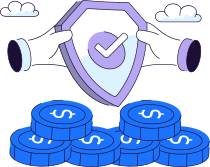
Thu phí và cung cấp thông tin
- Phí hồ sơ, đồng phục, đặt cọc.
- Yêu cầu nộp bản gốc giấy tờ.
- Cung cấp mã OTP.

Hứa hẹn trúng tuyển 100%
- Không yêu cầu trình độ.
- Không cần thử việc.
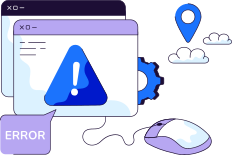
Phỏng vấn bất thường
- Địa điểm xa văn phòng công ty.
- Phỏng vấn qua Telegram.

Yêu cầu làm nhiệm vụ
- Tải app, nạp tiền.
- Làm nhiệm vụ nhận thưởng.

Tin tuyển dụng sơ sài
- Mô tả công việc chung chung
- Nhiệm vụ đơn giản, thu nhập khủng
- Lỗi chính tả, đánh máy.
Đội ngũ hỗ trợ của JobOKO sẵn sàng đồng hành, tư vấn và giới thiệu những cơ hội việc làm phù hợp, giúp Ứng viên tự tin phát triển sự nghiệp và chinh phục mục tiêu nghề nghiệp bền vững.
Hotline CSKH
1900.63.63.84
Công ty Cổ phần JobOKO Toàn cầu
Đội ngũ hỗ trợ của JobOKO luôn chủ động tư vấn các giải pháp tuyển dụng tối ưu, cam kết đồng hành và hỗ trợ Quý Nhà tuyển dụng đạt được hiệu quả tuyển dụng bền vững.
Hotline CSKH
0962.107.888
Công ty Cổ phần JobOKO Toàn cầu